


| Author: Abdullah Ahmed | Category: Content Management System Development
A museum changes its opening hours before a public holiday. The website updates, but the visitor app and entrance display still show the ordinary schedule. The organisation has several digital channels and no dependable way to manage the shared information behind them.
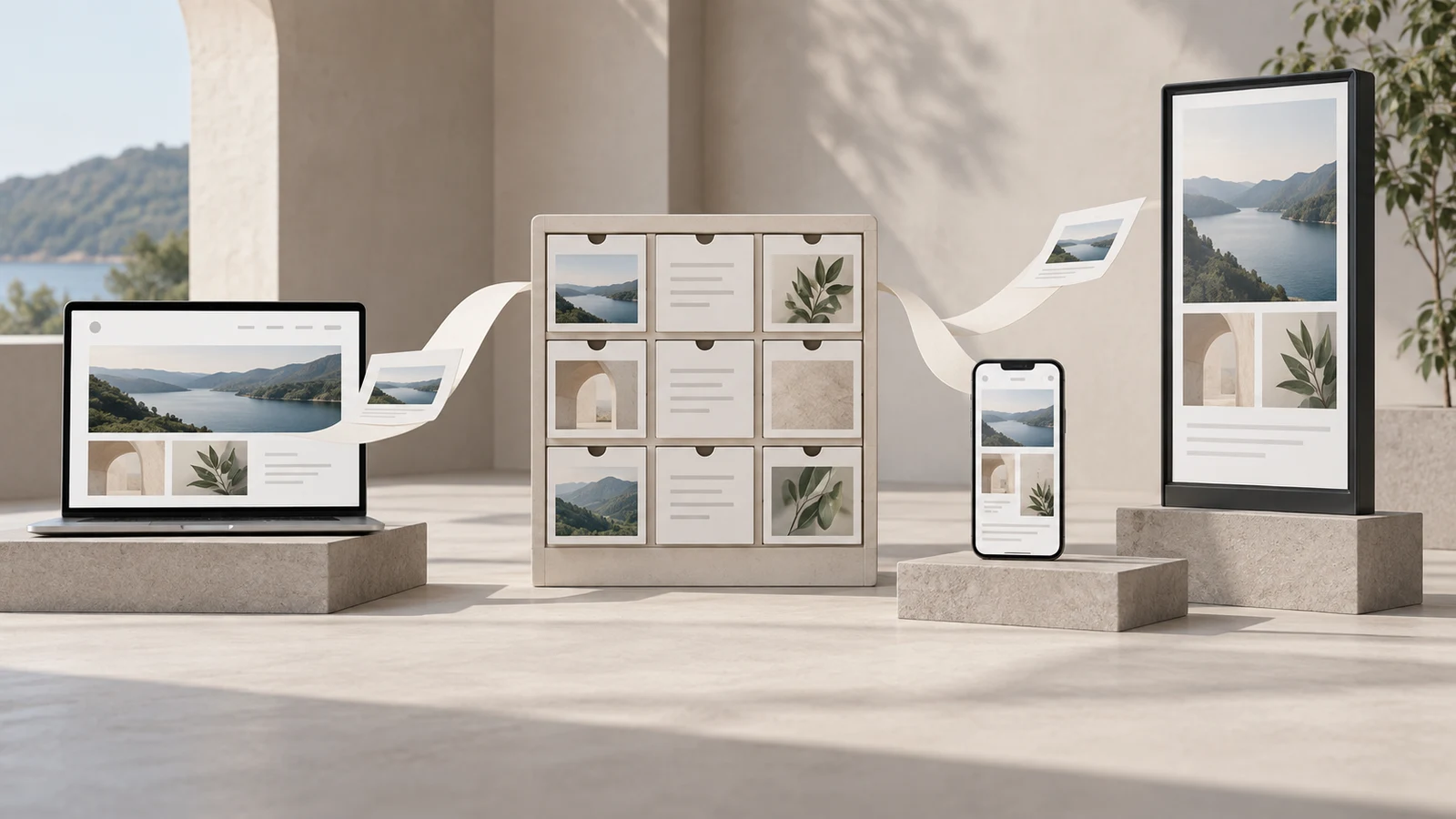
Headless CMS architecture can provide a common content source for multiple presentation applications. Its value depends on the content model, delivery contracts, preview experience, and publication process. Removing the built-in website layer does not automatically create consistent channels; those connections must be designed and operated deliberately.
Separate content responsibility from presentation
The CMS manages content and its editorial lifecycle. A website, mobile application, or display retrieves published information and presents it for its own context. This separation allows each channel to use an appropriate interface while sharing selected source material.
Define the boundary clearly. The CMS may own opening hours and descriptions, while the application owns navigation and interactive behaviour. Business transactions such as ticket availability may belong to another system rather than the content store.
Do not put every type of data into the CMS simply because it exposes an API. Transactional inventory, user permissions, and rapidly changing operational state may require different owners and guarantees. The architecture should reflect those differences.
Draw the complete delivery path for each channel. Include caches, build processes, API clients, and any transformations. Editors and operators need to understand how a saved change becomes a visible update.
Model shared meaning rather than one screen layout
A reusable opening-hours record should describe the location, dates, time ranges, and exceptions. Storing the information only as a formatted paragraph makes it harder for an application to calculate today's hours or display a concise sign.
Use fields and relationships that match the content's meaning. A location can reference services, accessibility information, and contact details. Each channel can then choose an appropriate presentation without parsing prose for important facts.
Keep narrative content flexible where it needs to be. A long article may require structured rich text rather than dozens of tiny fields. The model should support editorial work as well as delivery, and should be tested with real examples.
Avoid embedding assumptions from one channel into every record. A field named left-column-banner can couple content to a website layout. A more meaningful purpose, such as visitor notice, may support several presentations while remaining understandable to editors.
Distinguish shared content from channel-specific variation
Some information should remain identical across channels, while other content needs adaptation. A full description may suit a website; a concise summary may suit a small display. Define which variations are editorially managed and which are presentation decisions.
Give variations clear relationships to the source. If a short summary is separately edited, someone needs to know when the main description changes in a way that makes the summary inaccurate. Reuse can otherwise create a less visible form of duplication.
Consider accessibility and context. An image may need different treatment when it conveys essential information in one channel and is decorative in another. The content model and channel rules should preserve the intended meaning.
Use a representative cross-channel trial before finalising the schema. Show the same records on a website, phone, and display. Differences that look minor in the CMS often become obvious when real content meets each format.
Design the delivery API as a supported contract
Specify how consumers identify records, request language variants, follow relationships, and handle missing information. Stable identifiers are important when URLs, titles, or presentation routes change.
Choose query patterns that fit the channel's needs. A page may need a composed set of records, while a display may need a small schedule response. Avoid forcing each client to reconstruct a complex graph through many fragile requests without considering the cost.
Document pagination, limits, authentication, and expected error handling for the actual CMS service. Verify these capabilities against the selected plan and implementation. A general platform description is not enough for a delivery commitment.
Keep published and preview access separate. A public client should not receive credentials that expose drafts or administration. Test the boundary with direct requests rather than relying only on what the interface chooses to show.
Make schema evolution manageable
Content models change as the organisation learns. Adding a field may be straightforward, while renaming or removing one can break every consumer. Treat delivery schema changes as compatibility decisions.
Maintain sample records and checks for important channels. A website build and a mobile application may update on different schedules. The CMS must support the agreed transition period rather than assume all consumers release together.
Introduce replacements with a migration plan. Populate new fields, update consumers, confirm usage, and retire obsolete fields deliberately. Editors also need guidance so they do not maintain two representations indefinitely without understanding why.
Record the owner of each consumer. A forgotten display or old application version can preserve a dependency long after the main website has moved. Review real usage and supported versions before removing a contract.
Give editors useful preview
Editors need to judge content in context. A JSON response is not an adequate preview for most publishing decisions. Provide a way to inspect draft content in the relevant presentation layers.
Decide how preview combines linked records. A draft notice may reference a published location and an unpublished schedule. The preview should show the intended combination and make its status clear.
Protect preview access according to the material's sensitivity. Authentication, link scope, expiry, and sharing rules may all matter. A preview mechanism should not accidentally become an alternative public delivery path for unpublished content.
Test preview with the people who approve publication. If approval happens through screenshots because the preview is unreliable, the architecture has created a workflow gap that deserves explicit attention.
Coordinate publication across independent channels
Saving, approving, publishing in the CMS, and appearing in a channel can be separate events. Name those states and decide which ones editors need to see. A published label should not imply that every downstream cache has already updated unless that is actually guaranteed.
Use supported events or other update mechanisms to trigger builds and cache invalidation. Define retries and a repair path for missed updates. Repeated delivery should not create uncontrolled duplicate work.
For coordinated announcements, consider a release grouping or an agreed schedule across related records and channels. The implementation may vary, but editors need a reliable way to avoid exposing an incomplete set of information.
Provide evidence of delivery. A status view or targeted check can show whether the website and display have the intended version. This is especially valuable when urgent corrections must reach every channel.
Choose freshness and fallback by content type
An archive article, opening-hours exception, and emergency notice have different freshness needs. Define acceptable age and update expectations for each important type. A single cache policy may be unsuitable for all of them.
Decide what happens when the CMS is unavailable. A channel may continue serving a previously published copy where appropriate, with a clear age indicator if needed. Some information may require a more cautious response when freshness cannot be established.
Keep fallback behaviour honest. An old opening schedule should not be presented as verified current information if the application knows it could be outdated. The correct product response depends on the consequence of error.
Test recovery after service returns. Channels should catch up to the intended version without requiring manual edits in each presentation. Include checks for content removed or unpublished during the interruption.
Support localisation without losing relationships
Decide whether translations are separate records or variants within a shared entity according to the platform model. Preserve the relationship so channels can request the intended language and editors can see what remains untranslated.
Define fallback explicitly. Showing a source-language version may be acceptable for some content, while other information may need to remain unavailable until reviewed. Do not let a technical default make that editorial decision silently.
Account for regional differences beyond translation. Locations may have different services, dates, or eligibility rules. The model should distinguish genuine local variation from a translated copy of shared information.
Test long text, date formats, and missing variants in each channel. A delivery API can return valid content while the presentation truncates an important instruction or displays the wrong regional context.
Keep channel design and accessibility accountable
A common content source does not guarantee consistent or accessible presentation. Each channel needs suitable components, navigation, labels, and interaction. Assign those responsibilities to the teams delivering the experience.
Provide editorial guidance for headings, links, images, and structured rich text. The presentation layer should interpret those structures predictably. Avoid allowing arbitrary markup that behaves differently across channels without review.
Use shared design principles where they help, while respecting channel context. A public information display and an interactive mobile application should not be forced into identical layouts. Consistency should preserve meaning and recognisable identity.
Evaluate the complete task in each channel. Visitors may need to find today's hours on a phone or read a notice from a distance. Technical delivery success does not establish that the information is usable.
Operate the content platform as a shared dependency
Define service ownership, monitoring, backup coverage, and support arrangements. A central content service can simplify reuse while increasing the number of experiences affected by a failure or mistaken change.
Monitor delivery errors, stale content, build failures, and access problems. Alert the team that can resolve each issue. A green CMS dashboard does not prove that all consumers are showing the intended version.
Review costs across the complete architecture. Hosting, API activity, environments, presentation development, preview, and integration maintenance all contribute. Compare this with an integrated CMS using the same publishing requirements.
Keep export and recovery procedures practical. Test that content relationships, assets, and variants remain understandable outside the platform. Portability should be evidenced before the organisation urgently needs it.
Rehearse the holiday-hours change
Create a location record with normal hours and a holiday exception. Have an editor update the exception, preview it in the website and app, and schedule publication. Check the entrance display's refresh behaviour.
Interrupt one channel's update path and observe what staff see. They should be able to identify the stale channel and trigger the approved repair process. Verify that repeated updates do not create conflicting copies.
Then correct the published time and remove an obsolete notice. This tests the lifecycle beyond initial publication. Deletion and correction often expose gaps that a first-release demonstration misses.
Use the exercise to decide whether the architecture provides enough benefit for its operating cost. If the organisation has only one simple channel, a more integrated approach may remain suitable. If shared information drives several experiences, the trial can establish a concrete case for separation.
Define asset handling for each channel
Images, documents, and video need more than a shared file URL. Channels may require different sizes, crops, captions, and accessibility information. Decide which transformations are generated automatically and which need editorial choice.
Preserve the original asset and its identity where practical. Replacing an image should not leave some channels pointing to an obsolete copy without a clear update process. Versioning and cache behaviour should match the publication policy.
Give editors a way to inspect important crops. A wide website banner and a narrow phone card may show different parts of the same image. Automated resizing can be useful, but it should not remove the subject or essential visual information.
Consider document accessibility and lifecycle. A downloadable guide can remain outdated even when the structured page is corrected. Track it as a consumer or separately governed asset rather than assuming all channels are updated by changing one text field.
Include asset export in portability testing. Content references without the files, metadata, or relationships needed to interpret them do not provide a complete migration basis.
Clarify responsibility between the CMS and channel teams
When a page looks wrong, the cause may be content, schema, transformation, or presentation code. Define a support route that can identify the boundary without sending editors between several teams indefinitely.
Use a shared record identifier and published version in diagnostic tools where appropriate. This helps determine whether the channel received the intended content or rendered it incorrectly. Avoid requiring editors to understand raw API payloads for routine support.
Agree on review of content-model changes. Channel teams should know when a field or relationship is being introduced and what compatibility is expected. Editors should know when a new field becomes usable in each presentation.
Keep ownership of the overall publishing outcome explicit. Independent teams can still need one coordinator for a time-sensitive release. The architecture should support that responsibility rather than assume shared APIs remove it.
Write a channel contract in plain language
For the entrance display, the contract might identify which location records it consumes, how often it checks for changes, what version it currently shows, and what it displays when freshness cannot be confirmed. The website and mobile app can have different contracts where their needs differ.
Keep these agreements short enough for editors and operators to understand. They should explain the expected result and the repair route without requiring knowledge of the CMS's internal implementation.
Review the contracts whenever a new channel is added or an important content type changes. Reusing an API is technically easy compared with accepting responsibility for the information it presents. A clear agreement helps the organisation expand its channels without losing control of accuracy and publication timing.
Start with one reusable content domain
Choose information that is genuinely shared and difficult to keep accurate, such as locations, services, or product guidance. Define its model, owners, consumers, and freshness requirements before expanding the scope.
Build a complete slice that includes editing, preview, delivery, correction, and recovery. That proves more than an API response and gives editors a workable foundation.
Headless CMS architecture supports multiple channels when shared meaning survives the journey from authoring to presentation. Begin with that lifecycle and let the required responsibilities guide the technical design.
Author

With over 15 years of diverse experience spanning front-end and back-end development, UI/UX design, project management, integration, testing, and ongoing support for business applications, I specialize in transforming ideas into seamless digital solutions. I’m committed to leveraging my expertise to drive innovation and contribute meaningfully to the tech community.