


| Author: Abdullah Ahmed | Category: AI Automation
A delivery exception arrives while the service team is busy. The order platform records the problem, but nobody sees it until the next report. By then, the customer has called twice and a replacement has been arranged manually.
An event-driven workflow can respond when the exception is recorded. It can gather the order context, use AI to classify the carrier's explanation, and prepare a useful next action. The challenge is ensuring that the response remains correct when events arrive twice, arrive late, or describe a situation that has already changed.
Design the workflow around durable business state and explicit authority. AI can interpret the information; the surrounding system must decide whether an action is still relevant, permitted, and safe to execute.
Choose an event that means something to the business
A business event describes something that happened: a request was submitted, a shipment was delayed, or a document was accepted. It should have a clear producer and a meaning that consumers can rely on.
A database row update is not always a useful event. One user action may update several rows, while a routine maintenance operation may update a row without changing the business situation. Publishing raw changes without interpretation pushes that ambiguity onto every consumer.
For the delivery example, define what qualifies as an exception, where the status originates, and whether later messages can correct it. Include the order reference, occurrence time, event identifier, and schema version. Avoid putting unnecessary personal details into a message that several systems may receive.
Use past-tense names for facts and distinguish them from commands. “Shipment delayed” reports a state change. “Send replacement” asks a specific owner to act. Confusing the two makes it difficult to understand who has authority and whether a consumer may decline the request.
Draw the shortest useful reaction
Start with one event and one business outcome. A shipment exception might create an internal review task containing a suggested category and relevant order details. It need not immediately contact the customer, arrange stock, and update accounting.
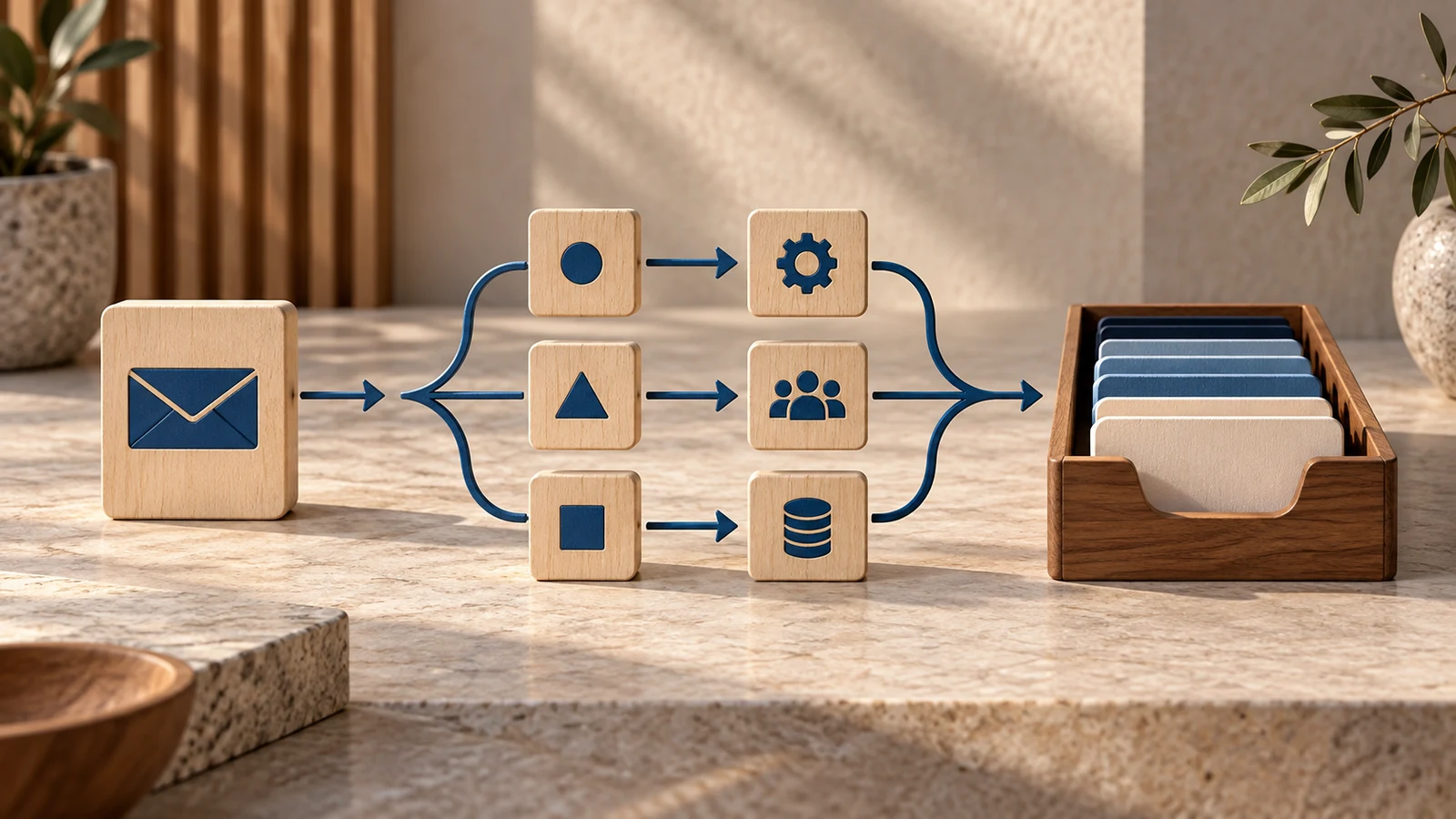
Map the reaction as separate stages: accept the event, verify it, retrieve current context, produce an interpretation, apply policy, and record the outcome. Keeping these stages explicit makes failures easier to diagnose and allows the AI step to change without rewriting the entire integration.
Give the workflow a durable identifier. Staff should be able to locate the same operation whether they start from the order, the incoming event, or a support report. Preserve the relationship between the trigger and any later actions.
Write the definition of done in business terms. “The worker finished” is insufficient. A review task should exist in the right queue, be linked to the correct order, and contain enough evidence for the assigned team to act.
Make event publication dependable
Consider a service that updates an order and then publishes an event. If it crashes between those operations, the order changes but the reaction never starts. Reversing the sequence creates a different problem: an event may announce a change that was never committed.
The transactional outbox pattern described by AWS addresses this dual-write gap by recording the business update and an outgoing message in the same database transaction. A separate publisher delivers the stored message. Consumers still need duplicate handling because delivery can be repeated.
Choose publication guarantees based on the actual source system. A third-party webhook may offer retries but no replay endpoint. In that case, a reconciliation process that checks for missed business changes can be part of the reliability design.
Monitor the publication path. A healthy order service does not prove its outbox is draining or its webhook destination is accepting messages. Expose the age of undelivered work and assign an owner who can investigate it.
Accept quickly and process durably
Keep the receiving endpoint focused on validating and storing the event. Long-running model calls inside a webhook request can exceed the sender's timeout and encourage retries while the original request is still processing.
Authenticate the source using the provider's supported mechanism, validate the message shape, and store accepted work before acknowledging it. The exact signature checks and replay controls depend on the sender; implement them against its current documentation.
Place heavy processing behind a durable queue or equivalent work store. Workers can then operate at a controlled rate, and temporary downstream failures need not make the receiving endpoint unavailable.
Define what an acknowledgement means. It should normally indicate that the event was accepted for processing, not that the final business action succeeded. Expose later completion through the workflow record so that operations teams are not misled by an early success response.
Use AI for interpretation with a bounded output
The AI step might classify a carrier note into an agreed set of exception types and extract a proposed delivery date. Ask for a structured result with explicit missing or uncertain values. Do not require the model to invent a date to satisfy a schema.
Validate the returned structure and the values themselves. A syntactically valid category can still be inappropriate for the source text. Where possible, attach evidence from the input so a reviewer can understand the suggestion.
Keep authority outside the interpretation step. The model should not choose arbitrary API endpoints, recipients, or credentials from the event text. Application policy determines which actions are available for the current order and user context.
Store the prompt or configuration version with the result. If a classification change causes a different routing pattern next month, maintainers need to identify which workflow version produced the earlier decision. Avoid recording sensitive source content in unrestricted logs.
Prevent duplicate effects at the action boundary
The same event can be delivered repeatedly. A worker can also crash after creating a task but before recording success locally. Event deduplication at intake helps, but it does not by itself resolve uncertainty around an external side effect.
Define an operation key for the intended business action. For example, a review task might be unique for an order, exception occurrence, and action type. Reuse that key when retrying the same operation, and persist the resulting external reference.
If the destination supports idempotency keys, follow its documented retention and conflict behaviour. If it does not, determine whether a unique business reference can be queried or enforced. A local “already processed” flag cannot atomically control an unrelated remote system.
When a request times out after it may have been accepted, classify the outcome as unknown. Query the destination or route the operation to reconciliation before repeating a consequential action. Treating every timeout as a clean failure is a common route to duplicate work.
Handle late events and changed circumstances
A shipment may be delayed at noon and delivered at one o'clock, while the delay event reaches the workflow at two. Acting on the old event without checking current state can produce an unnecessary customer warning or replacement proposal.
Before action, retrieve the authoritative current state and apply a relevance check. Preserve the event's occurrence time separately from the time your system received it. Those timestamps answer different questions during investigation.
Where order matters, use an explicit version or sequence for the relevant business entity if the producer supplies one. Do not assume timestamps from different systems establish a reliable total order. Decide how to handle missing predecessors and corrected events.
Record stale events as deliberately ignored with a reason. This is a legitimate outcome, distinct from failure. It lets operators explain why a trigger did not produce an action and prevents repeated investigation of expected behaviour.
Represent waiting and approval as real states
An automation that needs human review may remain open for hours or days. Store that state durably instead of keeping a worker running or relying on a browser session. Link the review decision to the exact proposed action.
A practical workflow might use states such as accepted, interpreting, awaiting review, executing, completed, rejected, and needs reconciliation. Define which transitions are allowed and what evidence is required for each.
Recheck the business state after approval. If the order was cancelled while the task waited, an earlier approval should not force an obsolete action. The approver authorised a particular proposal under particular conditions.
Make expiry and escalation visible. A review task that no one owns can leave the business process stuck even when every technical component is healthy. Queue age and ownership are therefore part of the workflow design.
Control bursts without overwhelming the business
Events often arrive unevenly. A partner reconnecting after an outage may send hours of accumulated changes at once. A bulk import may trigger thousands of reactions that are individually valid but operationally impractical.
Set concurrency and rate limits around model calls, downstream APIs, and human review capacity. Increasing worker count is useful only if the next stage can absorb the work. Otherwise, it moves the queue and may increase failures or cost.
Decide whether repeated changes can be coalesced. Several updates to the same low-risk summary may need only one refresh using current state. Other events, such as distinct approvals or adjustments, must remain separate. Make that choice by business meaning.
Use bounded retries with delay and a terminal recovery path. A permanently invalid message should not consume resources forever. Keep failed work accessible with a reason, relevant identifiers, and a controlled way to resume it after correction.
Design replay as an operational feature
Replay is useful after a bug fix or missed integration window, but historical inputs may no longer justify the same actions. Separate re-evaluating an interpretation from repeating its external effects.
Provide a preview mode that reports what would happen and why. For effectful replays, retain the original operation keys and consult the action ledger. Re-running an event under a new workflow version should not silently create a second task or message.
Limit replay scope by time, entity, event type, and maximum volume. Record who initiated it and which version processed the events. Operators need a stop control if the preview assumptions prove wrong.
Test replay using completed, rejected, stale, and uncertain cases. A recovery tool that handles only clean failures will leave the hardest incidents dependent on manual database edits.
Follow one delayed shipment through recovery
In a hypothetical workflow, a carrier reports that a shipment could not be delivered because the address was incomplete. The receiving service stores the event and creates a workflow record. A worker retrieves the current order and asks the interpretation step to classify the note and identify any missing address component.
The policy allows creation of an internal review task, but not an automatic address change. The task includes the carrier note, the current delivery details, and the proposed reason for review. Its operation key identifies this exception occurrence so a repeated event does not create another task.
The destination accepts the task, but the response is lost. The worker records an unknown outcome and stops automatic repetition. A reconciliation step queries the destination using the stable reference, finds the created task, and records confirmed completion. No second model call is needed to solve that transport problem.
Later, a delivery-completed event arrives. The workflow checks current shipment state and closes or updates the review task according to the business rule. It does not delete the earlier history: staff may still need to understand why a task was created and why no address change followed.
If the delay event arrives again the next day, it is recorded as already handled or stale. This outcome should be visible in diagnostics without generating an urgent alert. Repetition is expected delivery behaviour, while an unexplained new effect would be the defect.
Keep event evidence separate from decision evidence
The original event proves what the producer reported. The retrieved order snapshot explains the context used for the decision. The interpretation result records what the model suggested. The policy decision explains which action was allowed. Keep those roles distinguishable.
If a reviewer later corrects the classification, retain the correction and its reason. Do not rewrite the original event or pretend the system produced the corrected answer initially. The distinction supports both investigation and honest quality measurement.
Plan schema changes before consumers depend on them
Events become contracts once other systems react to them. Define how fields may be added, which values consumers must understand, and what happens when a message uses an unsupported version.
A new optional field can still change behaviour if a consumer assumes it is always absent. Test representative consumers and preserve examples of earlier event versions. Avoid changing the meaning of an existing field while keeping the same schema name.
Decide how long historical versions remain replayable. A recovery process may encounter old messages after the live producer has moved on. Keep an explicit migration or compatibility path where replay is part of the operating promise.
Version the interpretation and policy separately from the event contract. A carrier's message shape can remain stable while your organisation changes its review rules. That separation lets operators explain whether a different outcome came from new source data or a new decision process.
Verify the workflow through failure scenarios
Before launch, send the same event twice, deliver a correction before the original, stop a worker after an external call, and make a downstream service unavailable. Confirm that the workflow remains explainable and that no unintended duplicate effect occurs.
Also test valid but awkward inputs: an unknown order reference, ambiguous text, missing evidence, and a request outside the permitted policy. These cases should produce a clear operational outcome rather than an invented answer.
Measure time from business occurrence to useful completion, the proportion requiring review, retry volume, and unresolved outcomes. Separate model interpretation quality from integration reliability so improvements target the actual constraint.
For a first implementation, choose one trigger whose delayed handling already causes visible friction. Deliver a dependable internal action, prove recovery, and then decide whether a broader response is justified. That sequence turns an event into useful work without making the business depend on an opaque chain of automatic decisions.
Author

With over 15 years of diverse experience spanning front-end and back-end development, UI/UX design, project management, integration, testing, and ongoing support for business applications, I specialize in transforming ideas into seamless digital solutions. I’m committed to leveraging my expertise to drive innovation and contribute meaningfully to the tech community.